“Train up a child in the way he should go…” (Proverbs 22:6)
…but who should teach my child, and what should they teach?
The reality in our country today is that, typically, not only do both parents spend five days a week, 8–12 hours a day, away from their families, pursuing separate careers, but children are required to do the same—spending the most formative part of their time away from their parents and family. This makes meaningful family life during the weekdays almost impossible.
Sadly, the number of divorces and the number of children wounded by them remain very high, significantly weakening the next generation. The trauma associated with the breakdown of families has well-documented consequences. Those who experience the collapse of what they believed to be a “normal” family are, as adults, far less likely to believe that this model represents the successful framework for life. Having watched that model disintegrate before their eyes, they become more open to the increasingly aggressive false alternatives offered online, searching there for the ideal unity they saw shattered in their own homes. This is an understandable psychological process. Yet the last thing we want is for our children to seek hope in postmodern alternatives instead of healthy family structures simply because their own family failed to provide what it should have.
Another issue that deserves equally honest examination is that children cannot be protected from false and destructive ideologies by legal safeguards alone. Such protection can only come from within—from an internalized confidence, moral strength, and an inner wall of conviction that enables them to withstand whatever challenges arise. Governments change. Ideologies change. Technologies and cultural influences change. But if we fail to teach our children to think independently and critically, we deprive them of perhaps the greatest gift we are responsible for giving them. If, instead of cultivating their judgment, we keep them intellectually dependent and immature, they will never truly become adults.
The curriculum offered in today’s public education system is painfully inadequate when it comes to developing reasoning and debate skills. Instead of memorizing assertions, students should learn to examine them intelligently, explore them from multiple angles, and ask difficult questions. Instead of merely supplying the expected answers to teachers’ questions, they should be encouraged to ask thoughtful questions of their own, to seek answers together, and to engage in constructive, honest debate.
Children should be reading morally and intellectually demanding texts together and discussing them with enthusiasm. How many such treasures lie untouched in drawers! Instead, theories that are scientifically disputed are often presented as unquestionable facts for the sake of simplicity. And when someone is intellectually curious enough to discover evidence that challenges these hidden ideologies disguised as facts, that person is criticized. They become inconvenient.
Why does no one seem to notice that today’s educational system not only fails to teach the difference between scientific facts and scientific theories, but avoids even addressing the distinction? At the very least, science education should teach these differences. This is not a matter of faith; it is simply a matter of scientific integrity.
But no. Children should not think. They should not argue. Why? Simply because it is easier? Because there is no time for discussion? There is no time because students must memorize inhumane amounts of information for high-stakes tests—facts, or opinions presented as facts. This is precisely what makes children truly vulnerable. Building fences is not enough, because false ideologies will not stop at the gate.
This is especially true in today’s world, where even elementary schools openly struggle with the uncontrollable influence of the internet and the endless stream of content children share among themselves or access from virtually anywhere.
We are convinced—and we see countless living examples of this ourselves—that only virtues transmitted through relationships, modeled by example, and taught through daily life possess lasting power. Likewise, only a whole person, built upon critical thinking, the ability to reason, and a stable moral foundation, can withstand falsehood. Just as the person who best recognizes counterfeit money is the one who knows genuine currency well.
These two principles stand as defenders of educational freedom and the freedom to homeschool, just as our Constitution and the international legal instruments upon which it is based are intended to protect them.
The exercise of educational rights requires that parents be free to decide, in the best interests of their own well-known and deeply loved children, that they will not expose them to eight or more hours each day away from their families and to influences they neither know nor can effectively filter. Instead, parents should be able to fulfill their responsibility by educating their children through alternative means—in communities consistent with their own moral, religious, and ethical convictions, in smaller groups, with personalized intellectual challenges, under highly qualified professional guidance, yet within a framework of freedom. Our Constitution explicitly grants parents this right.
Responsibly safeguarding this possibility would make it possible, first, to fill the greatest void in modern family life: meaningful time spent with parents. It would allow families to become deeper, more cohesive communities and enable the practical transmission of a family’s heritage—whether a business, a farm, specialized knowledge, a worldview, or other valuable traditions.
But equally important would be helping parents themselves awaken to the realization that what they have become accustomed to—and what seems so natural, even though it often brings headaches and guilt, and though most people scarcely dare imagine anything better—is simply not good enough. It is not what we truly want to give our children.
We must wake up and realize that every parent bears far greater responsibility and possesses far greater opportunities than merely choosing which school within the existing system their child should attend. Parents have the power to raise children who think, perceive, feel, and act competently according to the good values they themselves hold.
This is my dream. And perhaps, here and now, it is no smaller than Martin Luther King’s dream was in his own time.
I can see parents truly present in their children’s lives. I can see them organizing themselves into communities built around the highest values because they want—and are able—to give their children more than disappearing into a classroom among strangers and peers. I see children who can openly and confidently relate to younger children, their peers, adults, the elderly, and public officials alike—children who are not disoriented when they leave the artificial environment of school. I see young people overflowing with ideas and capable of breaking those ideas down into practical steps toward realization.
Does that sound like a dream?
Then let our first step toward awakening be to open our eyes and look to places where people have already been living this reality for decades. Let us look beyond mere longing. Let us be the ones who dare to dream—and who dare to make those dreams reality.
Because the stakes are nothing less than our children. And our grandchildren. And those who, generations from now, will remember with gratitude the people who had the courage to step outside the box.
There are some of us already. Many are no longer in Hungary because remaining here became impossible for them, or because they chose countries where parents are granted at least a measure of educational freedom. Those of us who remain work mostly unseen, for the protection of children and families.
But there are not enough of us. Enough people together could bring about profound change. Let us dream. Let us desire it. Let us act.
Since I have already mentioned him, I will close with a quotation from Martin Luther King Jr.:
“Our lives begin to end the day we become silent about things that matter.”
— Martin Luther King Jr.
Notes
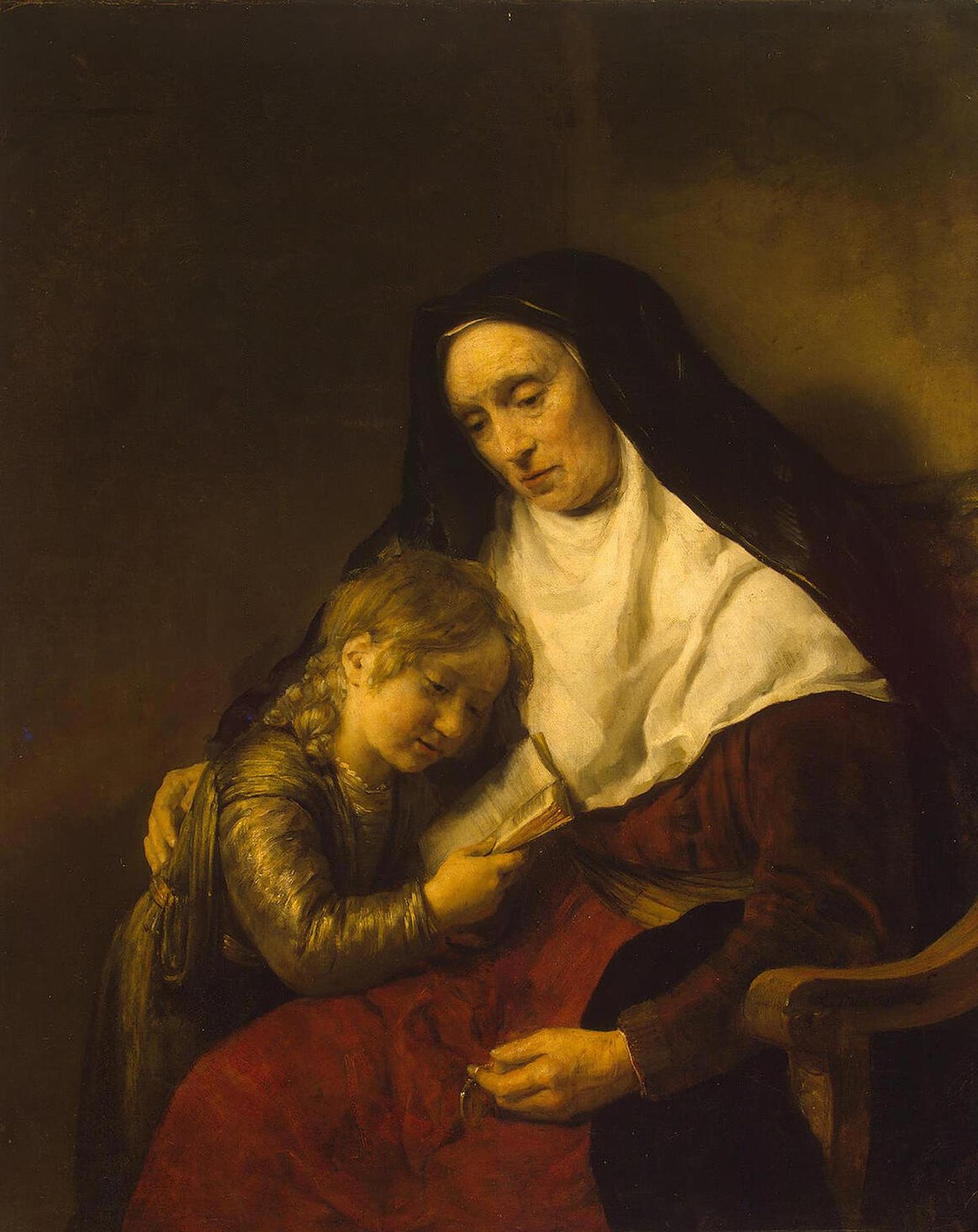
Cover art: Timothy with his Grandmother Lois by Willem Drost (1650–1654) (Forrás: Wikimedia)